


Antibodies are among the most effective and commercially successful medicines ever made. AI tools are increasingly capable of designing antibodies that can bind to particular targets, but binding is only the first step. Designing antibodies that become drugs for patients requires carefully dialing in diverse properties like binding, function, selectivity, stability, aggregation, and manufacturability. Changes that improve one property may pull against others, often in unintuitive ways. This multi-parameter optimization is one of the rate-limiting steps in drug development, and programs often spend months to years in lead optimization. In our collaboration with Anthropic, we investigated how frontier AI, powered with rapid feedback cycles and the right type of data, can transform this process and eliminate some of the guesswork in drug creation.
Today, we published our work with Anthropic showing how AI agents paired with scientists can tackle real-world antibody optimization problems in an AI-native lab. Over seven design rounds, one Anthropic researcher and Claude operated BigHat’s automated lab via MCP to optimize two antibodies, one VHH and one single-chain Fv (scFv), to enhance binding and stability while reducing aggregation. Claude was initially provided with minimal information: a single antibody sequence for each target, its baseline measurements, and the project goals. The most improved variants of both antibodies bound their targets up to nine times more tightly, including with sub-nanomolar affinity for one target, remained stable in solution at temperatures up to 18°C higher than the starting antibody, and aggregated far more slowly. Some did not fully aggregate even when exposed to 85°C conditions, the upper limit at which we could capture data on the existing instrumentation.
Claude’s capabilities in these tasks were impressive. Instead of executing a brute-force search, it reasoned like an experienced antibody engineer. Claude recognized both starting molecules as members of families already described in the patent literature and spotted that reversing a single difference from a published ancestor could significantly enhance binding for one starter. BigHat confirmed this in the first round of designs. From there, Claude and the researcher designed far more boldly than is typical. Human engineers usually change only one or two amino acids at a time, but about 150 of Claude’s designs sat 10 to 13 mutations away from the starting molecule. In one round, every one of the 65 heavily changed VHH designs still bound its target. Each of those calls rested on Claude seeing every result in context, round after round, and leveraging deep reasoning capabilities rather than just specialist models. And it was a true partnership: BigHat’s automated lab and scientific staff produced and measured every design, working alongside the researcher and Claude to refine the assays and collaborate on scientific questions as the projects progressed.
In total, we synthesized and comprehensively tested 1,232 antibodies in only 10 weeks across seven iterative design rounds between the two binder families, three for one family and four for the other. The designs in each round were shaped by the data from the last cycle. This is the fastest time to completion of any similar experiment that we are aware of. BigHat completed each design round in around one week, whereas most similar lab cycles would have taken at least 3-5x longer. We believe AI will help unlock new therapies for patients, and speeding up the feedback cycle is an important bottleneck to solve to realize this potential as quickly as possible.
BigHat’s unique platform sits at the heart of this work and uniquely enables this exciting collaborative outcome. For AI models of any scale to learn and meaningfully navigate the complex relationships between protein sequence and function, the process, quality, reproducibility, and observability of data and metadata collection are paramount. There are several large published datasets that contain some antibody properties, but models trained on these datasets have limited predictive capacity because every lab uses different instruments and procedures. By contrast, BigHat’s highly standardized and automated lab environment generates extremely high-quality data, reducing the quantity of data required to train highly predictive models. Coupled with the speed and throughput of cell-free protein synthesis, our iterative cycles of design-build-test further enhance model performance and quality of antibody designs beyond what is achievable in other labs.
Importantly, a rapid and standardized physical laboratory is only one piece of the puzzle. As we have seen in other domains, the harness matters. BigHat and Anthropic’s results required Reccy™, BigHat’s Agentic Lab Control Harness that drives our wet lab, stores all of our data, and is accessible to Claude by MCP. From day one, we built Reccy to be the source of truth for everything our lab does: every molecule, every physical sample, every instrument run, every protocol, and every result, all connected and visible in real time. That meant Claude could trace any design to the exact sample that was made, the instrument that measured it, and the settings used that day. Raw instrument output sits alongside the summary numbers and both Reccy’s own QC warnings and instrument-provided QC flags, so results can be carefully evaluated. Even the project goals live in the system with quantitative objectives, so Claude knew exactly what counted as success and how each property was scored.
This level of visibility, data harmonization, and lab management is unprecedented, not just between drug developers and their CROs, but even within a single organization. Every scientist has been frustrated by how lab instruments run black-box software with proprietary inputs, with disjointed and messy output files. In contrast, Reccy fluently communicates across instrument platforms and joins experimental data with antibody design and analysis tools seamlessly. This was critical in our collaboration. We saw how the default software of a gold-standard machine that measures antibody thermostability was making incorrect calls for antibody unfolding and aggregation events. Reccy correctly flagged the results as misleading. Claude accessed the instrument observations through Reccy and reasoned through a biophysical model that explained the trends in the raw data. Claude and the researcher proposed a change to the heating protocol, varying protein concentration and heating rate, and BigHat’s results ultimately supported this model. The team subsequently optimized towards a new summary score and markedly improved antibody thermal stability.
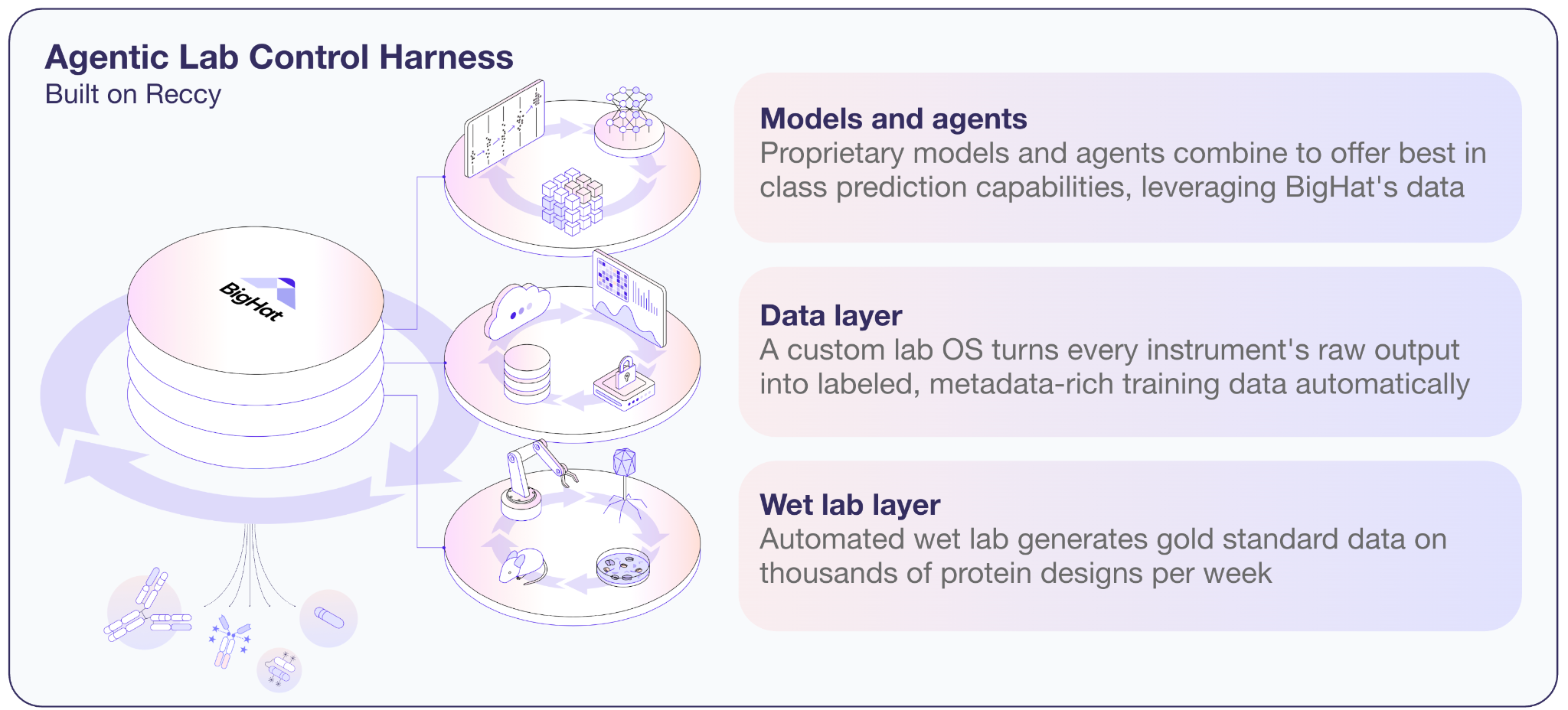
The lessons and opportunities here are clear. Frontier models are increasingly capable - the bottleneck is shifting to the data, the lab, and the harness. Integrating frontier intelligence with labs like BigHat’s Milliner platform and Reccy data control layer transforms drug development to a reliable and scalable engineering discipline that delivers ideal compounds the first time around. With an agent and BigHat's lab, our collective ability to design transformative new medicines is limited only by the biology we understand, rather than the drugs we can create.
Our pilot marks the start of a broader therapeutics initiative between BigHat and Anthropic aimed at increasingly difficult problems, where much less is decided up front [Learn more here]. We are giving scientists and Claude open goals, such as conceiving and creating a drug candidate for an exceptionally challenging target, collaborating around what kind of molecule to make, and deciding which experiments to run. Most importantly, we are dedicated to continuing our quest for speed and quality so that we can help bring drugs to patients and their families.


